

What is a passive system in nuclear power?
A passive system is a nuclear safety system capable of performing its functions without human intervention or an external power supply, relying solely on natural physical laws — gravity, natural convection, pressure, and thermal conduction.
In Small Modular Reactors (SMRs), passive systems can play a key role in enhancing safety thanks to their simplicity and robustness, reducing design complexity with fewer active components and redundancies, and improving the competitiveness and standardisation of future reactors, particularly SMRs.
However, their licensing remains complex, requiring the development of new, dedicated tests to validate specific calculation models, and the adaptation of safety analysis methodologies.
A pioneering international gathering
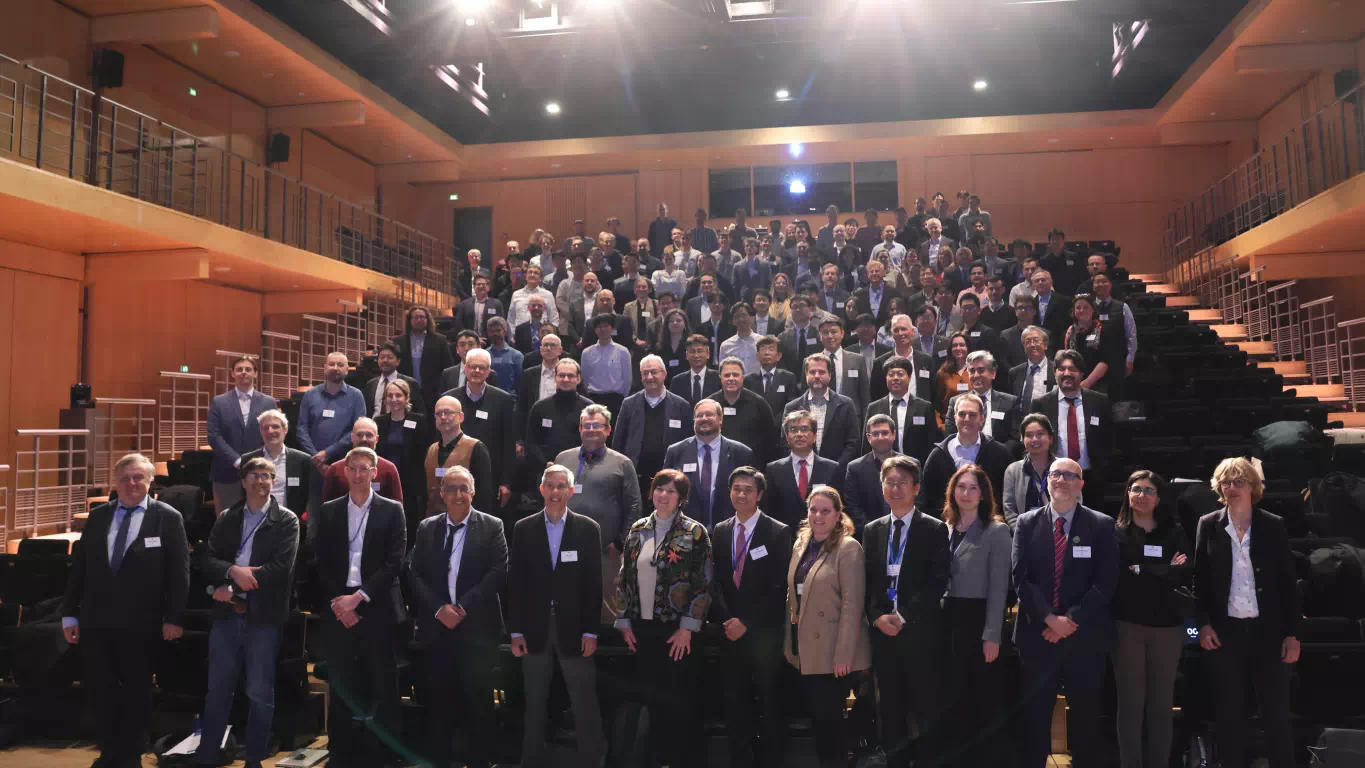
From 30 March to 1 April, the Paris Japan Cultural Center hosted a landmark workshop that brought together more than 150 participants from across the globe to address these critical challenges. Three institutions co-organised the event: the OECD Nuclear Energy Agency (NEA), the EASI-SMR project, the International Atomic Energy Agency (IAEA)
The three-day meeting provided multiple sessions to discuss, exchange information, and coordinate activities on potential synergies as well as common challenges — particularly the lack of consensus regarding modelling approaches, reliability assessment, and crediting methods in safety analyses.
The workshop brought together a wide range of stakeholders, including reactor designers, safety authorities, experimental teams, computational code developers, specialists in deterministic and probabilistic safety analysis, and experts in human and organisational factors. This diversity of expertise enabled a comprehensive overview of the state of the art to be drawn up, technological bottlenecks to be identified, and numerous cross-disciplinary issues to be highlighted.
Programme highlights
The workshop opened with a welcome from Véronique Rouyer, Head of NEA Division of Nuclear Safety Technology and Regulation, followed by Yuji Kumagai, Senior Nuclear Safety Specialist at NEA, who presented an overview and logistics of the different workshop sessions.
Sessions covered a wide range of topics, from international initiatives on passive systems to Deterministic Safety Assessment (DSA) and Probabilistic Safety Assessment (PSA), licensing challenges, and lessons learned from vendors and regulators. Day 2 featured simultaneous sessions on experimental programmes and code verification and validation (V&V), allowing participants to dive deep into specific technical areas while maintaining broad coverage across the workshop.
The event concluded with a technical visit to EDF Lab Chatou, EDF's R&D center in western Paris, where a select group of participants toured facilities including POOL-LOOP, ZEPHYR, and EVEREST — connecting the workshop's theoretical discussions to tangible experimental infrastructure and allowing direct engagement with the teams at the heart of these facilities.
Key Takeaways
- Cross-community dialogue: The workshop successfully bridged experimentalists, code developers, safety analysts, vendors, and regulators, creating valuable exchanges on methodologies and best practices.
- Regulatory and operational insights: Sessions brought together real-world deployment stories from vendors alongside regulatory expectations from NRC, CNSC, KINS, and ONR, offering a comprehensive view of the licensing landscape.
- From theory to practice: The technical visit to EDF's R&D facilities (POOL-LOOP, ZEPHYR, and EVEREST) connected the workshop's theoretical discussions to tangible experimental infrastructure.
- New collaborative pathways: The workshop fostered the emergence of new avenues for scientific and methodological collaboration across disciplines.
EASI-SMR's active participation
The EASI-SMR project was present throughout the event, with presentations and active participation across different sessions.
- Nicolas Sobecki (Project Coordinator, EDF) presented an overview of passive systems activities in the EASI-SMR project. He has also shared his perspective on the workshop in an article on EDF's website (in French).
- Fulvio Mascari (WP3, ENEA) shared perspectives on reliability of passive systems and co-presented with Franck Morin (WP2 Lead, CEA) on the project's experimental programme and code validation activities.
- Petr Bízek (WP4 Lead, UJV) presented WP4's work on reliability of passive systems.
- Kateryna Piliuhina (WP8 Lead) moderated the panel discussion on regulatory and operational challenges.
Towards an international roadmap
The conclusions of the workshop will form the basis of an OECD/NEA report, prepared in collaboration with EASI-SMR. This report will set out a roadmap aimed at:
- overcoming the main barriers identified in order to strengthen the safety demonstration of passive systems
- improving the international consistency of analytical approaches
- supporting the acceleration of SMR licensing in Europe